Basics
Kratom Extract vs Powder: Labels, Strength and Price per mg
Sep
Published September 18, 2026 · Updated
Kratom Extract vs Powder: Labels, Strength and Price per mg
Kratom extract vs powder is the first choice most shoppers face, and the label is where the two formats split.
At Kratom Folk, we read every label before a product goes live.
So this guide sticks to what labels actually say.
You will see how each format starts, how brands state strength, and how to work out price per mg yourself.
We also cover storage and the state laws that split leaf from extracts.
We make no effect claims, and we give no dosing advice.
Kratom Extract vs Powder at a Glance
Here is the short version before the detail. Each point gets its own section further down.
- Raw powder is dried, milled Mitragyna speciosa leaf. Nothing gets concentrated.
- An extract starts as leaf, then the maker pulls out and concentrates the alkaloids.
- Powder labels usually list weight in grams, while the COA shows alkaloid content.
- Extract labels usually state mg of extract or mg of mitragynine per bottle, shot or tablet.
- Price per mg works cleanly for extracts, because they print a mg figure. Raw leaf needs the COA.
- Utah and West Virginia allow leaf-style products only, so extracts do not ship there.
What Raw Kratom Powder Is
Raw powder is the leaf itself, dried and ground fine. It is the oldest retail format and the simplest one.
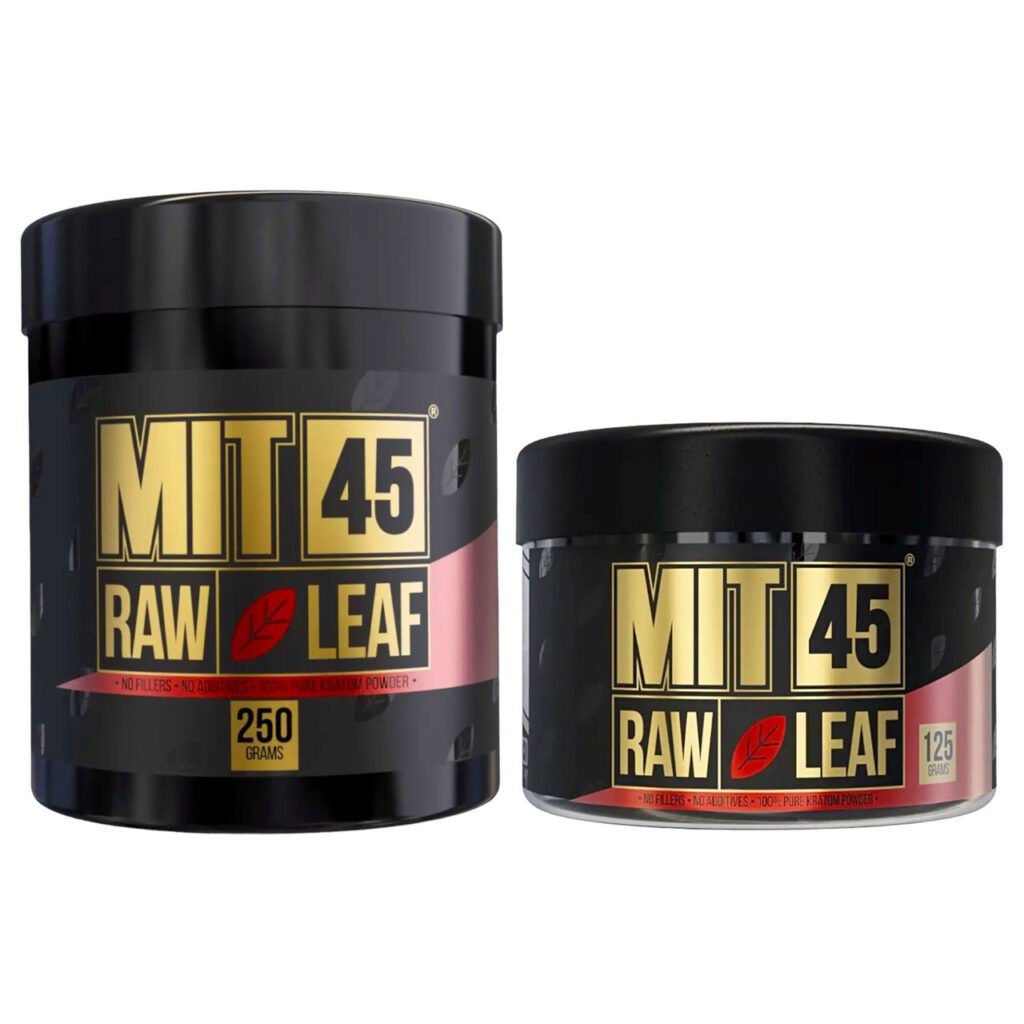
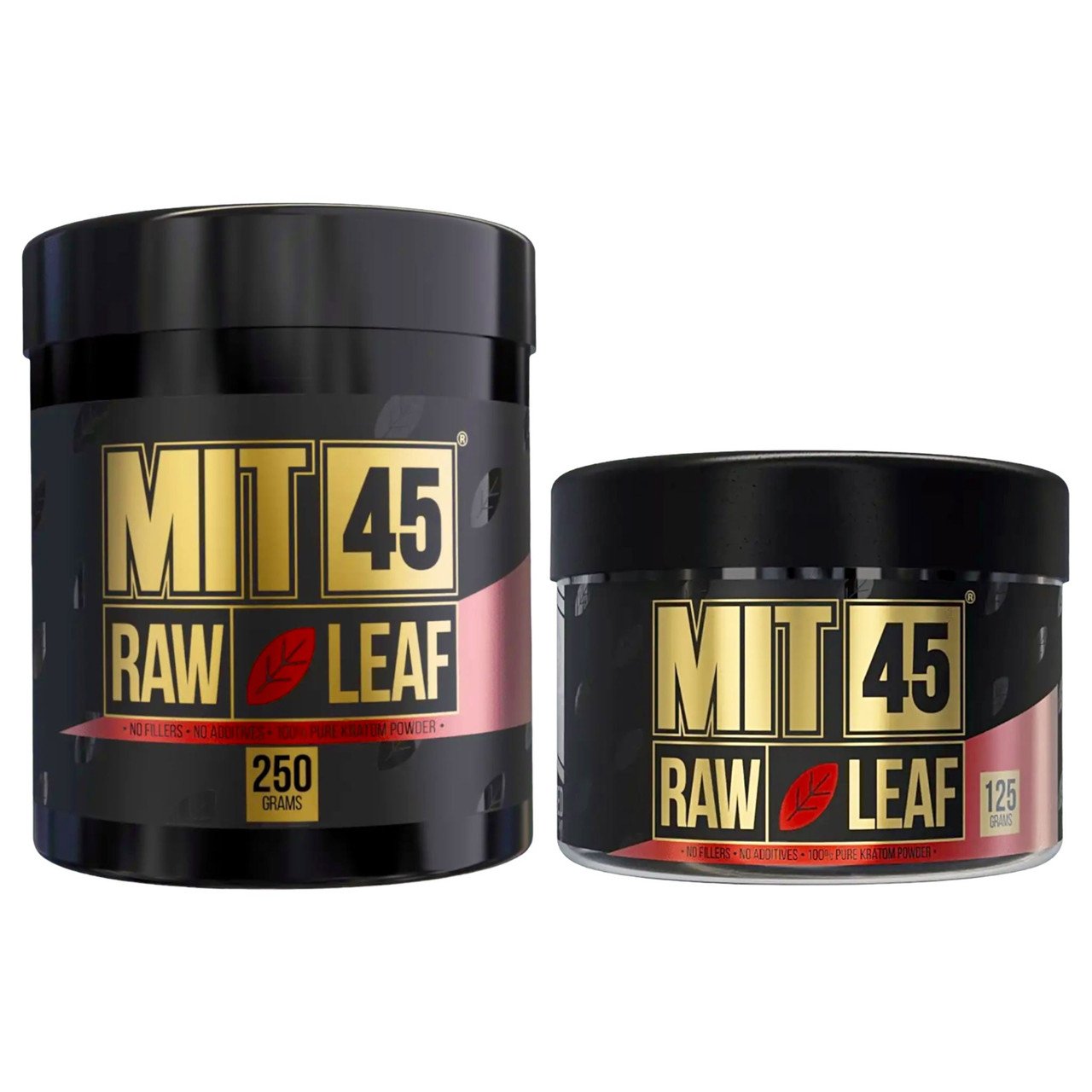
For example, MIT45 Raw Leaf Kratom Powder holds dried, milled leaf that the brand does not concentrate in any way.
MIT45 sells it by vein color.
Red and White list at $12.85, while Green lists at $12.60 at time of writing.
Similarly, OPMS Silver Kratom Powder comes in two single-origin strains.
Red Vein Sumatra and White Vein Indo both list at $9.55.
OPMS places its Silver range below its Gold and Black extract lines.
That tells you the brand itself sees leaf and extract as separate tiers.
Why single-origin leaf matters to some buyers
Single-strain powders let you compare origins side by side. Blends make that comparison much harder.
Vein color is a naming convention, not a strength rating.
Vendors attach mood words to colors, but we do not repeat them as fact.
If you want the background on vein names, read our guide to red, green and white kratom.
Raw leaf in capsules is still raw leaf
Capsules do not turn leaf into an extract. MIT45 Raw Leaf Kratom Capsules hold the same leaf as the powder.
The only change is the shell.
So a raw-leaf capsule belongs on the powder side of this comparison, not the extract side.
The same goes for OPMS Silver Red Vein Sumatra capsules, which list at $5.89 at time of writing.
Trying leaf without a full bag
If you want to try raw leaf in a smaller amount, samplers help.
OPMS sells a Silver Maeng Da sampler in two formats.
The powder sampler lists at $18.82, while the capsule sampler lists at $13.24.
Both hold the same Maeng Da leaf. So the sampler lets you compare loose powder with capsules from one source.
Maeng Da is a trade name for a selected leaf grade, not a separate species.
Our Maeng Da guide explains the name.
What a Kratom Extract Is
An extract begins as leaf, too. However, the maker separates the alkaloids from the plant material and concentrates them.
Brands describe this step in their own words. MIT45, for instance, calls its Gold tincture triple-purified and batch-tested.
The finished extract then goes into a carrier.
That might be a liquid, a capsule, a pressed tablet or a gummy.
The main extract formats
- Tinctures and shots: liquid extract in a small bottle, such as MIT45 Gold.
- Extract capsules: concentrated extract in a shell, such as MIT45 Black Label.
- Tablets and chewables: pressed extract with flavor, such as K Shot Tabs.
- Gummies: extract in a chewy base, such as Hush gummies.
- Syrups: extract in a thick flavored liquid, such as MIT45 Go.
Every one of these sits in our kratom extracts category. Raw leaf sits in kratom powder and capsules.
What concentration changes
Concentration changes the label, the size and the legal treatment. It also changes how much a single unit can contain.
Researchers describe mitragynine as the predominant alkaloid in kratom leaf, at roughly 12 to 66% of total alkaloid content.
An extract raises that alkaloid share relative to plant fiber.
As a result, a tiny bottle can list more mitragynine than a scoop of leaf.
That is a label fact, not a recommendation.
A bigger number on the pack tells you what is inside, and nothing more.

How the Labels Differ: Percent vs mg
This is where most confusion starts. Leaf and extracts use different units, so a straight comparison needs a little care.
Percent of leaf alkaloids
Raw-leaf labels rarely print mg per serving on the front.
Instead, the batch COA reports alkaloids as a percent of dry weight.
For example, a COA might show mitragynine as a percentage. You then multiply that by the grams in the bag.
So a 1% figure means 10mg of mitragynine per gram of leaf.
That math only works with the COA in hand.
Our listings for raw leaf do not show a mg figure.
Therefore, check the lot number against our lab results library.
mg per bottle, shot or tablet
Extract labels usually lead with mg. Some state mg of total extract, while others state mg of mitragynine.
Those are two different numbers. Total extract includes every compound in the concentrate, while mitragynine is one alkaloid inside it.
MIT45 prints both on Gold. The bottle lists 250mg extract and 125mg mitragynine.
A worked label example
Do the division and 125 out of 250 is 50%. Yet the brand name still says 45.
That gap has a simple history. The older Gold packaging carried 112.5mg mitragynine, which is exactly 45% of 250mg.
Now the current bottle carries about 10% more mitragynine. So the name stayed while the label number moved.
Lessons like this are why we tell readers to trust the printed mg, not the product name.
Our mitragynine percentage guide goes deeper.
Other MIT45 label math
- Super K: 500mg extract and 150mg mitragynine, which works out to 30%.
- Super K Extra Strong: 1,250mg extract and 375mg mitragynine, also 30%.
- Go pouch: 150mg extract at 65% mitragynine, so about 97.5mg mitragynine.
Notice that the extract with the most total mg is not the one with the highest percentage.
Both figures matter when you compare.
Price per mg: Real Catalog Math
Price per mg turns a messy shelf into one comparable number. Here is how we calculate it for this guide.
- First, find the mg figure on the label and note whether it is extract or mitragynine.
- Next, multiply mg per unit by the count in the pack.
- Then divide the price by that total mg.
Prices below are reference retail prices at time of writing, in October 2026. Prices change, so read these as snapshots.
| Product | Format | Label figure | Price | Price per mg |
|---|---|---|---|---|
| MIT45 Gold | Liquid extract | 125mg mitragynine | $17.99 | about $0.144 per mg MIT |
| MIT45 Super K | Liquid extract | 150mg mitragynine | $12.97 | about $0.086 per mg MIT |
| MIT45 Super K Extra Strong | Liquid extract | 375mg mitragynine | $24.97 | about $0.067 per mg MIT |
| MIT45 Go | Syrup pouch | about 97.5mg mitragynine | $9.97 | about $0.102 per mg MIT |
| K Tropix 110mg MIT shot | Liquid extract | 110mg mitragynine | $10.69 | about $0.097 per mg MIT |
| Opia Mitragynine 150mg 4ct | Chewable tablet | 600mg mitragynine per pack | $19.75 | about $0.033 per mg MIT |
| Hydroxie Mit 100mg 10ct | Chewable tablet | 1,000mg mitragynine per pack | $10.65 | about $0.011 per mg MIT |
| K Shot Tabs 200mg 4ct | Extract tablet | 800mg extract per pack | $17.50 | about $0.022 per mg extract |
| MIT45 Raw Leaf Powder | Raw leaf | Grams on bag, alkaloids on COA | $12.60 to $12.85 | Needs COA figures |
| OPMS Silver Powder | Raw leaf | Grams on bag, alkaloids on COA | $9.55 | Needs COA figures |
How to read that table
Compare mitragynine rows with mitragynine rows. Mixing a mg-of-extract figure with a mg-of-mitragynine figure skews the result.
For example, K Shot Tabs look cheap per mg. But that figure counts total extract, not mitragynine alone.
Also, bigger packs tend to cost less per mg.
Super K Extra Strong beats a single Gold on this measure for that reason.
Raw leaf often costs less per mg of mitragynine.
Still, you can only confirm that with the COA figures for your batch.
Price per mg is not the whole story
A low price per mg says nothing about taste, convenience or what a format suits.
It is one input, not a verdict.
Some buyers pay more per mg for a flavored chewable or a pocket bottle.
That is a fair trade if format matters to you.
Common Label Mistakes to Avoid
Most comparison errors come from reading the wrong line on the pack. These are the ones we see most often.
Reading the product name as a strength
Names like Gold, Black, Extra Strong or Ultra are brand tiers. They do not tell you mg on their own.
For instance, OPMS prices its Gold, Black and Red extract capsules the same, at $11.00 each.
So the tier name signals a different blend, not a cheaper or pricier one. Read the label for figures.
Comparing per bottle instead of per mg
A $9.97 pouch looks cheaper than a $17.99 bottle. However, the per-mg math can tell a different story.
In this case, Go still works out cheaper per mg of mitragynine than Gold.
The gap is just smaller than the sticker suggests.
Ignoring the pack count
Tablet packs vary from single tablets to ten-count packs. Always multiply mg per tablet by the count first.
For example, Hydroxie Mit lists ten 100mg tablets. Meanwhile, the 7 Stax 80mg blend tablet sells as a single.
Skipping the 7-OH line
Extract labels sometimes state 7-OH content. Opia, for example, labels its 150mg extract chewables as under 1% 7-OH.
That line matters in states with 7-OH caps. Also, it separates leaf-style extracts from the products in our 7-OH category.
Losing the lot number
Once you toss the box, you lose the easiest route to the COA.
Keep the pack, or photograph the lot code.
Our guide to reading a kratom COA shows where each figure sits on a real report.
Taste, Convenience and Format
Raw powder tastes bitter and earthy.
Many buyers mix it into a drink, while others prefer leaf capsules to skip the taste.
Extracts take up far less space. A 10mL shot or a four-count tablet pack fits in a pocket.
Flavor systems also differ. MIT45 Go, for instance, uses honey, orange and cinnamon to soften the bitterness.
Meanwhile, Gold keeps a short ingredient list: vegetable glycerin, water, citric acid and kratom extract.
Measuring and consistency
Powder needs a scale or scoop, and you measure it yourself. Extracts arrive pre-portioned by bottle, tablet or capsule.
That fixed portion makes label reading easier. However, it also means the unit size is the brand’s choice, not yours.
If you compare shots often, our best kratom shots roundup lays out mg and price across brands.
Storage: Leaf vs Extract
Both formats keep best when you control air, light, heat and moisture. Yet each format has its own weak spot.
Storing raw powder
- Keep the bag sealed tight, or move the powder to an airtight container.
- Store it somewhere cool, dark and dry, away from a stove or sunny window.
- Use a dry scoop every time, because moisture causes clumping.
- Keep the original label or lot number, so you can still match the COA later.
Storing extracts
- Cap liquids tightly and keep them upright, so they do not leak in a bag.
- Keep tablets and gummies in their original pack until you open them.
- Check the best-by date printed on the pack, since extracts carry their own dates.
- Keep every format out of reach of children and pets, especially flavored ones.
For a fuller checklist, see how to store kratom so it lasts.
Legal Differences Between Leaf and Extracts
This is the part many guides skip. In some states, the law handles leaf and extracts very differently.
The details below come from our state legal tracker, current as of 6 October 2026.
Laws change quickly, and this is not legal advice.
Utah: pure leaf only
Utah passed SB 45, “Kratom Adjustments,” signed 26 March 2026.
From 6 May 2026, only pure leaf kratom may be prepared or sold.
So extracts, shots and concentrated tablets cannot ship to Utah. Raw leaf can, and buyers must be 21 or older.
West Virginia: natural-leaf profile only
West Virginia amended its Kratom Act through SB 985, effective 12 June 2026.
The law allows only a natural-leaf alkaloid profile.
It excludes products that are synthetically manipulated or chemically concentrated.
As a result, we ship leaf products only to West Virginia.
States that ban both
Several states ban kratom in every form, including Alabama, Arkansas, Indiana, Tennessee, Wisconsin and Vermont.
In those states the extract vs leaf question does not arise. Neither format can ship there.
7-OH caps hit extracts harder
Some states cap 7-OH. Georgia, for example, allows no more than 0.5mg per gram and 1mg per serving.
Because extracts concentrate alkaloids, these caps matter more for extracts than for plain leaf. Check each label against your state.
The federal picture
Federally, kratom leaf and mitragynine remain unscheduled. The DEA has proposed temporary Schedule I placement for 7-OH above set thresholds.
That notice of intent appeared on 6 July 2026 at 91 FR 40917.
As of 6 October 2026, no final order has issued.
Its proposed thresholds are above 0.05%, or above 1mg per unit for processed products.
So extracts would face the closer test.
FDA has also said its 7-OH action targets concentrated products, not natural kratom leaf.
Follow updates on our kratom legality hub and 7-OH legal status page.
Kratom Extract vs Powder: How to Choose
Choose by format, label clarity, price per mg and where you live. Never choose by a vendor’s promise about effects.
Pick raw powder if
- You want the plain leaf with nothing concentrated or added.
- You are happy to measure, and you will read the batch COA.
- Price per gram matters more to you than portability.
- You live in Utah or West Virginia, where leaf is the legal option.
Pick an extract if
- You want a printed mg figure on every unit.
- Pocket size and pre-portioned packs matter to you.
- You prefer a flavored format, such as a chewable or syrup.
- Your state allows extracts and any 7-OH content on the label.
Questions to ask any label
- Does it state mg of extract, mg of mitragynine, or both?
- Does it list 7-OH content, and does that meet your state’s limit?
- Is there a lot number you can match to a COA?
- What is the price per mg once you count every unit?
Our guide to reading a kratom label walks through each line of a real pack.
Frequently Asked Questions
Is kratom extract just stronger powder?
Not quite. An extract concentrates the alkaloids and drops most plant fiber, so the label and legal status both change.
Are raw-leaf capsules an extract?
No. Raw-leaf capsules hold ground leaf in a shell. The MIT45 and OPMS Silver capsules both work this way.
Why do some extracts list two mg numbers?
One number covers total extract, and the other covers mitragynine alone. MIT45 Gold, for example, prints 250mg and 125mg.
Which is cheaper per mg?
Raw leaf often is, but you need the COA to confirm it.
Among extracts, larger packs tend to cost less per mg.
Can I buy extracts in Utah or West Virginia?
No. Both states now allow leaf-style products only. Check our legality hub before ordering, because rules keep changing.
Should I talk to a doctor first?
Yes. Talk to a doctor before using any kratom product, and never mix kratom with alcohol or other substances.
The Bottom Line
The difference comes down to processing and the label.
Powder is plain leaf, while an extract concentrates what the leaf contains.
So read the mg figure, match the lot to its COA, and check your state first.
Then the kratom extract vs powder choice gets simple.
Browse raw kratom powder, kratom extracts or our full shop. Every product is for adults 21+ only.
Sources
- Federal Register, DEA notice of intent on 7-OH, 91 FR 40917 (6 Jul 2026)
- FDA press announcement on 7-OH products (29 Jul 2025)
- Zhang et al., Frontiers in Plant Science (2020), kratom alkaloid content
- Utah SB 45 (2026), Kratom Adjustments
- West Virginia SB 985 (2026), enrolled bill
- Georgia Kratom Consumer Protection Act guidance
These statements have not been evaluated by the Food and Drug Administration. Kratom products are not intended to diagnose, treat, cure or prevent any disease. Sold only to adults 21 and over where lawful. This article is general information, not medical or legal advice. See our FDA disclaimer.
